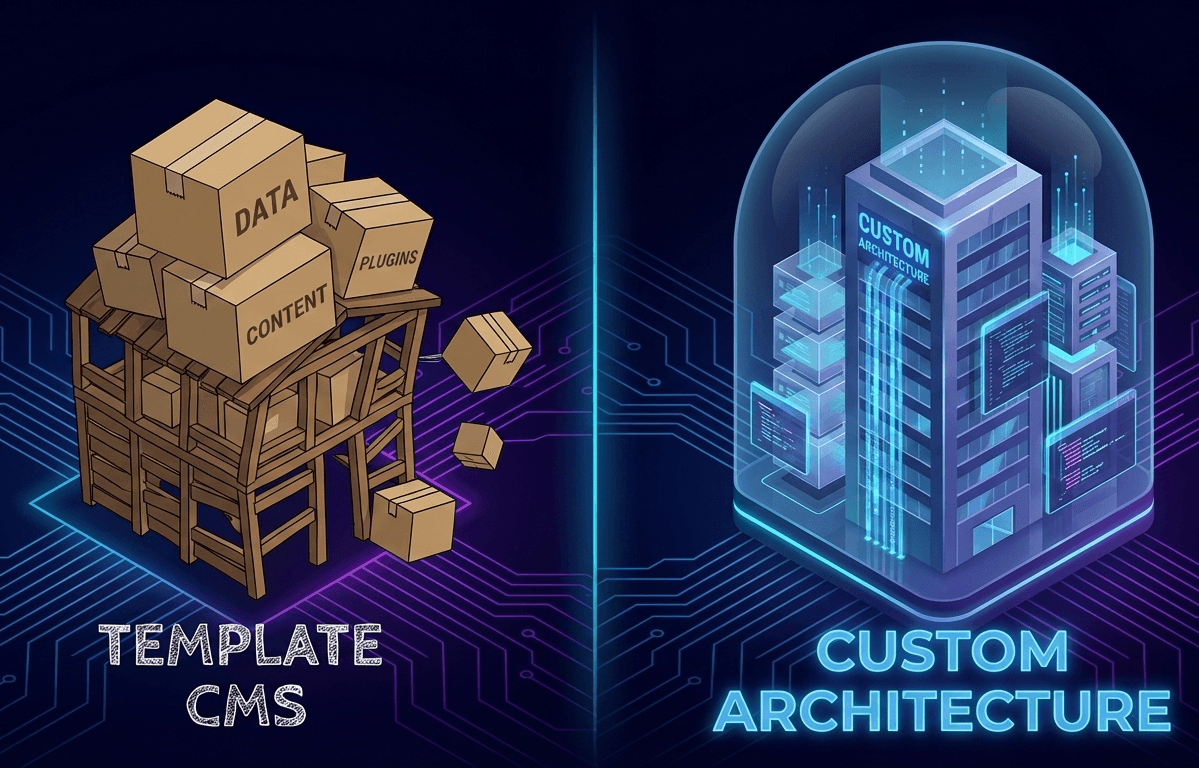
Custom Web Architecture vs. CMS: Scaling Your Digital Infrastructure in 2026
In the early lifecycle of a venture, speed to market is the primary metric of success. Low-code platforms and Content Management Systems (CMS) like WordPress or Shopify serve a vital purpose: they bridge the gap between idea and execution rapidly.
However, as organizations mature, the digital landscape shifts from "presence" to "performance." By 2026, user expectations for sub-second latency, data sovereignty, and complex integrations have rendered many off-the-shelf solutions obsolete for scaling businesses.
If your operational capacity is being throttled by the very tools that helped you launch, you are facing a critical inflection point. This article examines the strategic necessity of transitioning from generic CMS platforms to custom, scalable web architecture.
1. The Hidden Cost of "Technical Debt" in CMS
CMS platforms are engineered for mass appeal, not specific performance. To accommodate every possible user—from hobbyists to enterprises—they rely on bloated codebases and heavy dependency chains.
For a growing business, this results in significant technical debt:
Performance Overhead: Generic themes often load unused scripts and CSS on every page request. This "code bloat" directly impacts Core Web Vitals, resulting in sluggish load times that increase bounce rates.
Security Exposure: Because popular CMS file structures are open-source and widely known, they are frequent targets for automated botnet attacks and SQL injection vulnerabilities.
Integration Rigidity: Attempting to force a CMS to perform complex tasks—such as dynamic pricing engines or AI-driven analytics—often requires "hacking" core files, which breaks upgrade paths and destabilizes the system.
2. The Strategic Advantage of Custom Architecture
At Phobolytics, we advocate for a transition from "rented land" to proprietary infrastructure. Utilizing modern frameworks such as React, Next.js, and Node.js (The MERN Stack), we engineer platforms where every line of code serves a business function.
Precision Performance
Custom applications utilize "lazy loading" and server-side rendering (SSR). This ensures that users only download the code required for their immediate interaction, dramatically reducing load times and improving SEO rankings.
Elastic Scalability
Unlike a CMS hosted on a shared server, custom architectures are cloud-native. By leveraging services like AWS or Google Cloud, your infrastructure can auto-scale—allocating more resources during viral traffic spikes and scaling down during lulls—ensuring 99.99% uptime and cost efficiency.
Intellectual Property Valuation
A proprietary platform is a tangible asset. It increases your company's valuation during investment rounds, demonstrating that you own your technology rather than relying on third-party plugins.
3. Critical Indicators: When to Migrate
Migration is a significant decision. We recommend a technical audit if your organization is experiencing the following friction points:
The "Plugin Patchwork" Effect
If your current site relies on 15+ plugins to achieve basic functionality, you have created a fragile ecosystem where one update can crash the entire site.
Data Silos
Your website cannot communicate effectively with your CRM, ERP, or internal proprietary tools, leading to manual data entry and operational inefficiencies.
Mobile Latency
Your interface provides a degraded experience on mobile devices due to non-responsive theme elements that cannot be optimized.
4. The Phobolytics Approach: Engineering Ecosystems
We do not simply write code; we architect digital ecosystems. Our development philosophy integrates your frontend presence with backend intelligence.
Modular Design: We build using component-based architecture, allowing for rapid feature iteration without disrupting the core system.
Advanced Integrations: Seamlessly connect your web platform with our Computer Vision or AI Solutions, turning your website into an intelligent business tool.
Security by Design: We implement enterprise-grade security protocols, including custom authentication layers and encrypted data transmission, from Day 1.
Conclusion
A template is a starting line, not a destination. As your business scales, your infrastructure must evolve from a passive display of information to an active engine of growth.
Transitioning to custom architecture is not merely a technical upgrade—it is a strategic investment in efficiency, security, and future capability.
Is your infrastructure ready for the next level?
Contact Phobolytics for a comprehensive architectural consultation. Let us build a platform that scales as fast as your ambition.