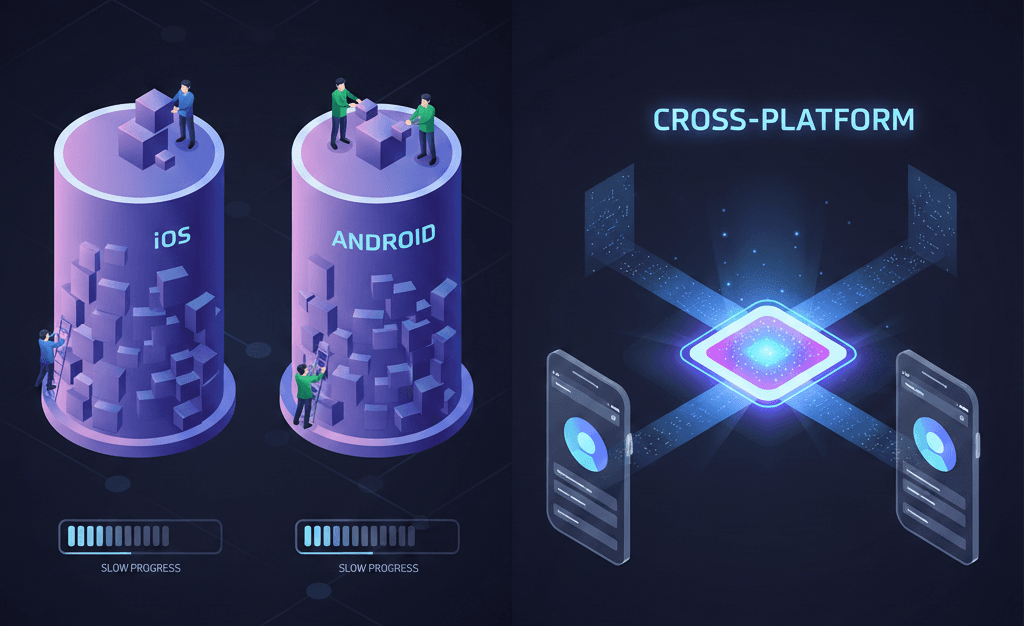
Native vs. Cross-Platform: Choosing the Right Mobile Tech Stack for Your Startup in 2026
For any founder building a mobile product, the first technical crossroads is often the most critical: "Do we build Native or Cross-Platform?"
Five years ago, the answer was simple. If you wanted performance, you built Native (Swift for iOS, Java for Android). If you wanted cheap and fast, you built Cross-Platform. But in 2026, that binary distinction has collapsed.
Frameworks like Flutter and React Native have matured into enterprise-grade solutions, powering giants like Uber, Airbnb, and Instagram. Yet, "purist" arguments for Native development persist.
This article dissects the trade-offs to help you choose the architecture that aligns with your business goals, budget, and timeline.
1. The Native Approach: Maximum Power, Maximum Cost
Native development involves writing two completely separate codebases: one in Swift/SwiftUI for iOS and another in Kotlin/Jetpack Compose for Android.
The Pros
Raw Performance: For graphics-intensive applications—like 3D gaming or high-frequency trading apps—Native code accesses the device’s GPU and CPU directly with zero abstraction layers.
Immediate API Access: When Apple or Google releases a new feature (like a new AR kit), Native developers can use it on Day 1.
The Cons
The "Double Tax": You need two separate teams. A feature change on iOS doesn't magically appear on Android; it must be re-coded, doubled testing, and doubled maintenance costs.
Slower Time-to-Market: Coordinating two development cycles inevitably leads to one platform lagging behind the other.
2. The Cross-Platform Revolution: Efficiency at Scale
Cross-platform frameworks allow developers to write code once and deploy it to both iOS and Android. In 2026, this is no longer just "wrapping a website in an app container"—it is compiling to near-native code.
Why It Wins for Startups
Unified Codebase: You write ~90% of your code once. Logic, state management, and API integrations are shared.
Feature Parity: Your iOS and Android users get the same updates at the same time. No "Android second-class citizen" syndrome.
Cost Efficiency: You reduce development hours by roughly 40-50%, freeing up budget for marketing or user acquisition.
Performance in 2026
Modern engines (like Flutter’s Impeller) have eliminated the "jank" associated with early hybrid apps. For 95% of business applications—e-commerce, SaaS dashboards, booking systems, social platforms—the performance difference is imperceptible to the end user.
3. Decision Matrix: Which Stack Fits Your Project?
Feature Requirement | Recommended Stack | Why? |
|---|---|---|
Complex 3D Games / AR | Native | Requires direct, low-level GPU access without bridges. |
SaaS / E-commerce / Social | Cross-Platform | Data-driven apps perform identically on hybrid stacks. |
Tight Budget / MVP | Cross-Platform | Fastest route to validate your idea on both markets. |
Heavy Hardware Access | Hybrid / Native | If you need deep Bluetooth/NFC integration, Native is safer, though Flutter is catching up. |
4. The Phobolytics Approach: "Smart Hybrid"
At Phobolytics, we prioritize business outcomes. For most of our clients, we recommend a Cross-Platform First strategy using modern frameworks.
However, we recognize that "one size fits all" is a fallacy. Our "Smart Hybrid" methodology involves:
Core Logic in Cross-Platform: We build the UI and business logic in a unified framework to ensure speed and consistency.
Native Bridges for Power: If your app needs a specific high-performance module (like a custom Face Recognition camera stream), we write that specific module in Native code and bridge it seamlessy.
This gives you the best of both worlds: the development speed of React Native/Flutter with the raw power of Native where it actually matters.
Conclusion
Your users do not care about your tech stack; they care about the experience. In 2026, unless you are building the next high-fidelity graphical game, the "Native or Nothing" mindset is a financial liability.
Choosing a Cross-Platform architecture allows you to move faster, iterate based on user feedback, and dominate both app stores simultaneously.
Planning your next mobile product?
Consult Phobolytics today. Whether you need a rapid MVP or a high-scale ecosystem, we build apps that perform.